Cat Face Days of the Week: A Designer Review
As a designer who has spent years navigating the intersection of digital graphics and tangible textile art, I approach every new pattern with a critical eye. The market is flooded with generic motifs, but finding a cohesive set that balances charm with practical application is rare. Recently, I evaluated Cat Face Days of the Week, a hand-drawn graphic series intended specifically for hand stitching and needlepoint projects. Unlike the typical vector-heavy files designed for high-speed digitizing, this collection feels distinctly human. It is explicitly noted as not suitable for machine embroidery, which immediately shifts the conversation from technical stitch density to artistic interpretation and thread choice.
First Impressions: Mood and Visual Personality
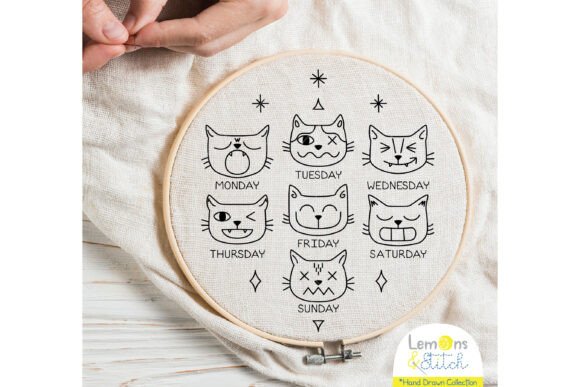
When I first opened the file to review the layout, the immediate impression was one of whimsical consistency. Each cat face in the Cat Face Days of the Week set carries a unique expression that corresponds to the energy of that specific day, yet they remain visually unified. This is crucial for anyone planning a weekly tracker or a calendar-themed handmade product. The lines are clean but possess enough organic variation to avoid looking like a stamped logo. For an Etsy seller or boutique owner, this "hand-drawn" aesthetic translates directly into perceived value. Customers today crave items that feel made by hand, not mass-produced by a computer algorithm.
The visual weight of these graphics is balanced perfectly for needlepoint. Because they are not machine designs, there is no need to worry about complex underlays or satin stitch caps. Instead, the focus is on how the outlines will be interpreted through running stitch, backstitch, or chain stitch. The simplicity of the faces allows the texture of the fabric and the sheen of the floss to become part of the design itself, rather than fighting against dense fill stitches.
A Real-World Scenario: The Custom Nursery Tracker
To truly test the viability of this pattern, I imagined a specific client project: a custom embroidered pillow cover for a nursery. The client wanted a functional piece that could track the week while serving as decor. Using Cat Face Days of the Week at a 6-inch size, I visualized how the design would sit on a soft cotton canvas. The playful nature of the cats makes them ideal for baby embroidery, offering a gentle touch that fits perfectly alongside other nursery themes without being overwhelming.
In this scenario, the design acts as the focal point. If I were selling this as a finished product in my small shop, the clear distinction between each day's character would encourage interaction. Parents often love personalized gifts that have a story or a function. By stitching these faces onto a neutral background, perhaps with contrasting thread colors for the eyes and whiskers, the final piece becomes a conversation starter. It moves beyond a simple decorative item to become a cherished family artifact. This kind of engagement is exactly what separates a generic craft fair item from a sought-after boutique product.
Performance in Hand Stitching and Needlepoint
Since this is a hand embroidery pattern, the execution relies entirely on the maker's skill and material choices. The available sizes—ranging from 3 to 8 inches—offer significant flexibility. For a small hoop project like a keychain or a bookmark, the 3-inch version works beautifully. However, for larger applications like a tote bag design or a kitchen towel, scaling up to 7 or 8 inches ensures the details remain crisp without requiring microscopic stitching.
One of the most refreshing aspects of Cat Face Days of the Week is the absence of machine-specific constraints. There is no risk of puckering due to excessive stitch density, nor do you need to calculate pull compensation. This makes it an excellent choice for beginners who want to create professional-looking results without mastering complex digitizing software. The graphics are straightforward, allowing the crafter to focus on tension control and color blending. Whether using perle cotton for a raised effect or standard stranded floss for a flat finish, the design adapts well to various techniques.
Strategic Considerations for Fabric and Placement
While the versatility of this pattern is high, there are specific situations where careful planning is required. When working with textured fabrics, such as heavy denim for custom apparel or thick wool for winter accessories, the fine lines of the cat faces might get lost if the wrong thread weight is chosen. In these cases, using a thicker floss or doubling strands is essential to maintain visibility. Similarly, on stretchy fabrics like jersey knit used for sweatshirt embroidery, the design must be hooped tightly or stabilized heavily to prevent distortion during the stitching process.
Dark fabrics present another challenge. While the graphic is bold, stitching light-colored thread on a black background requires precision to avoid gaps that show the dark fabric underneath. Conversely, using dark thread on light fabric can sometimes look too stark unless softened with shading techniques. For products that will undergo frequent washing, such as aprons or tea towels, ensuring the stitches are secure and the stabilizer is appropriate is vital to longevity. I always recommend testing the design on scrap fabric first, especially when trying a new combination of thread colors and material textures.
Business Value and Commercial Application
For creative entrepreneurs and digital product sellers, Cat Face Days of the Week offers a strong asset for building a brand identity. The consistent style across all seven days allows for a cohesive product line, whether you are creating printable mockups to showcase your work or producing physical goods. The "hand-drawn" quality adds a layer of authenticity that resonates with buyers looking for handmade products over factory-made alternatives.
However, before launching a commercial line, it is imperative to confirm the licensing terms. As with any digital embroidery file or graphic asset, understanding whether you can sell the finished items, offer the pattern as a download, or use it for branding is critical. Assuming you have the proper rights, this design can elevate an Etsy listing significantly. It provides a unique selling proposition that stands out in a crowded marketplace. The ability to offer personalized gifts, such as a "Monday Blues" patch or a "Sunday Rest" pillow, taps into the emotional connection customers seek in their purchases.
Practical Designer Notes for Success
If you decide to incorporate Cat Face Days of the Week into your workflow, keep these practical tips in mind:
- Test Your Hoop Size: Even though the design comes in multiple sizes, always verify that your hoop accommodates the full layout plus a margin for stability. A cramped hoop leads to uneven tension.
- Check Contrast: Before committing to a large project, stitch a small section to ensure your thread colors pop against your chosen fabric. What looks good on screen may appear muddy in reality.
- Stabilizer Matters: Since this is for hand stitching, a water-soluble stabilizer or even a simple tear-away can help keep the fabric taut, especially on woven materials prone to shifting.
- Mockup First: Create a black and white mockup of your intended finished product. This helps you visualize the scale and placement without the distraction of color.
- Respect the Medium: Remember that this is not a machine embroidery design. Do not attempt to digitize it for an automated machine, as the lack of stitch direction data will result in poor coverage and potential breakage.
Ultimately, Cat Face Days of the Week is a thoughtful addition to any hand embroidery patterns library. It bridges the gap between cute aesthetics and functional design, offering makers a versatile tool for creating meaningful, high-quality goods. Whether you are crafting a holiday gift for a friend or stocking shelves for your craft business, this graphic provides the foundation for projects that feel personal, professional, and undeniably charming.